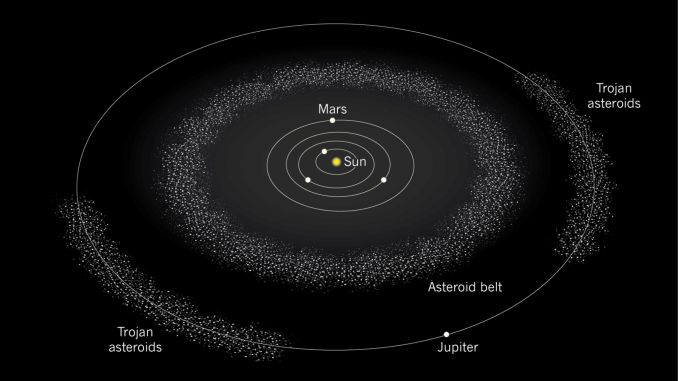
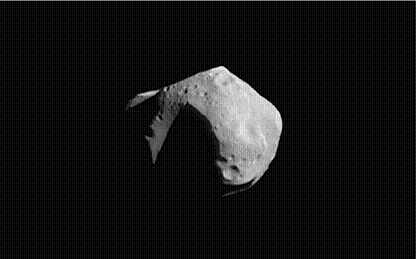
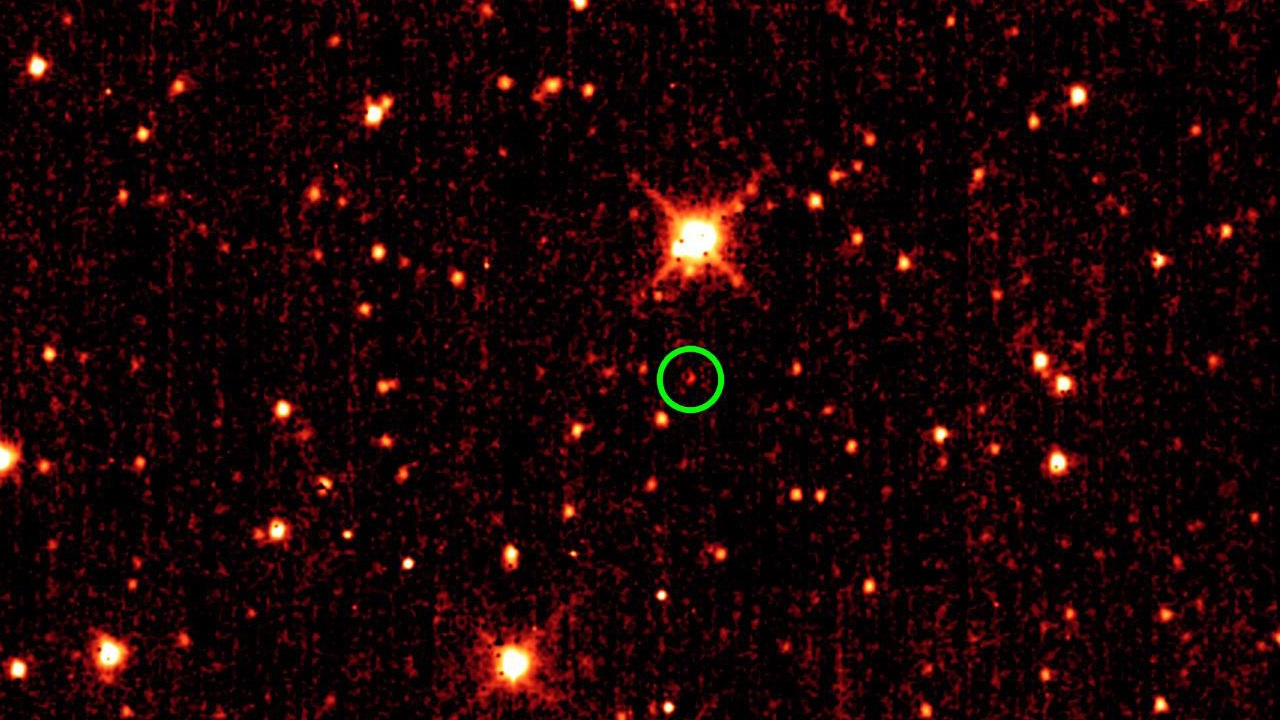
Trojans are asteroids that share orbit with a planet around the stable Lagrange points L4 and L5, which are located 60° in front and 60° behind the planet in its orbit. An asteroid is a rocky celestial body of the Solar System, smaller than a planet and larger than a meteoroid. Trojan asteroids are distributed in two elongated and curved regions around the Lagrange points and, in the case of Jupiter, with a semi-axis greater than 5.2 AU. Earth also has a Trojan asteroid, which accompanies it on its journey around the Sun, which is around 300 meters in diameter and has been named 2010 TK7. Generally the term refers to Jupiter's Trojan asteroids, which make up the vast majority, although some have also been found in the orbits of Mars and Neptune. As of April 2010, the number of Known Trojans numbered over 4,000, and of these only 10 do not belong to Jupiter, the first Trojan, Achilles, was discovered in 1906 by the German astronomer Max Wolf. The name Trojans is due to the fact that, by convention, each member was named after a mythological figure from the Trojan War. Trojans are dark bodies whose emission sp