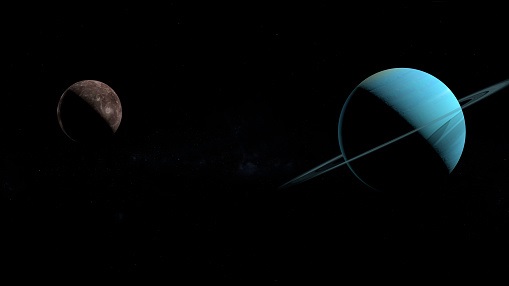
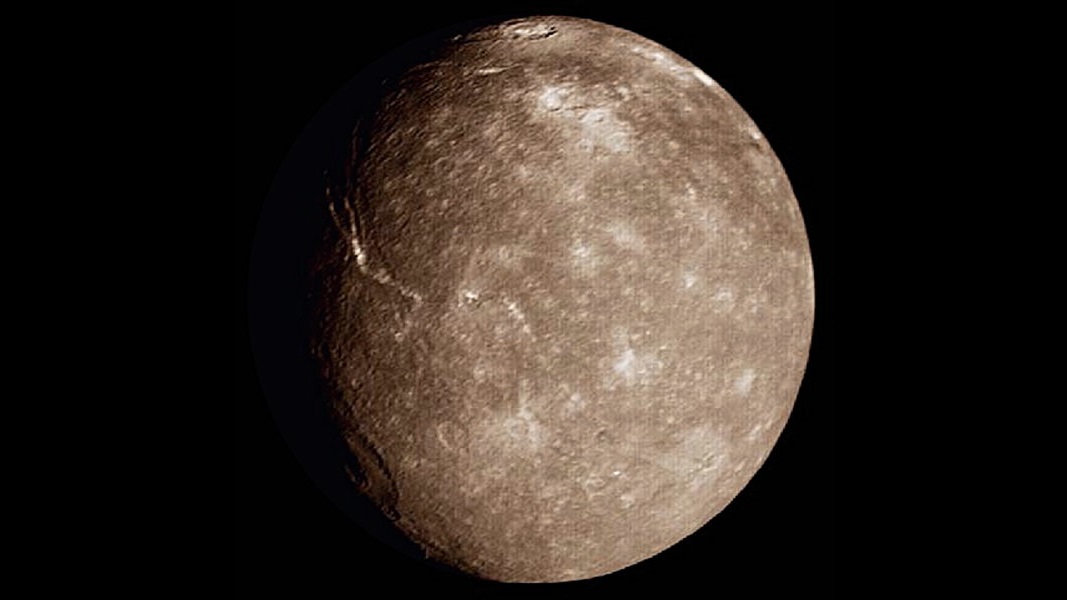
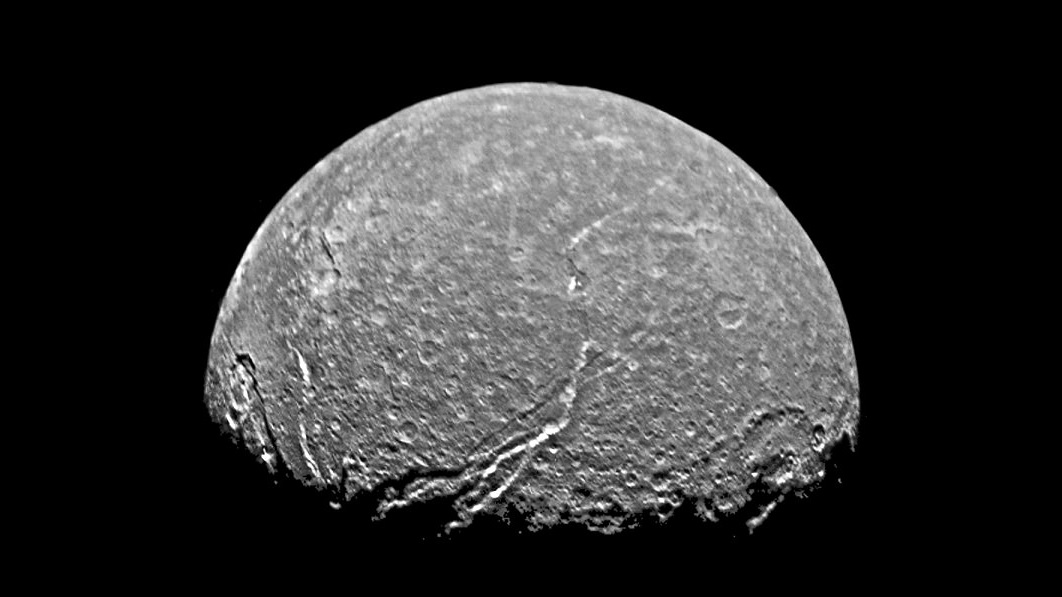
Titania is the largest of the satellites on the planet Uranus and the eighth in the Solar System. Discovered by William Herschel in 1787, Titania gets its name from a character in English literature. Its orbit is completely within Uranus' magnetosphere. Titania is made up of roughly equal parts of ice and rock that are probably differentiated into a rocky core and an ice sheet. A layer of liquid water may be present at the boundary between the core and the mantle. Titania's surface, which is dark and slightly reddish in color, appears to have been shaped by both impact and endogenous processes. It is covered by numerous impact craters reaching diameters of more than 300 km, but it is less craterized than Uranus' outermost satellite, Oberon. Titania likely underwent endogenous surface remodeling that removed an older, more craterized surface. Titania's surface is traversed by a system of huge canyons and scarps resulting from expansion at an early stage in its evolution. Like all Uranus satellites, Titania probably formed from the accretion disk surrounding Uranus just after the planet's formation.